
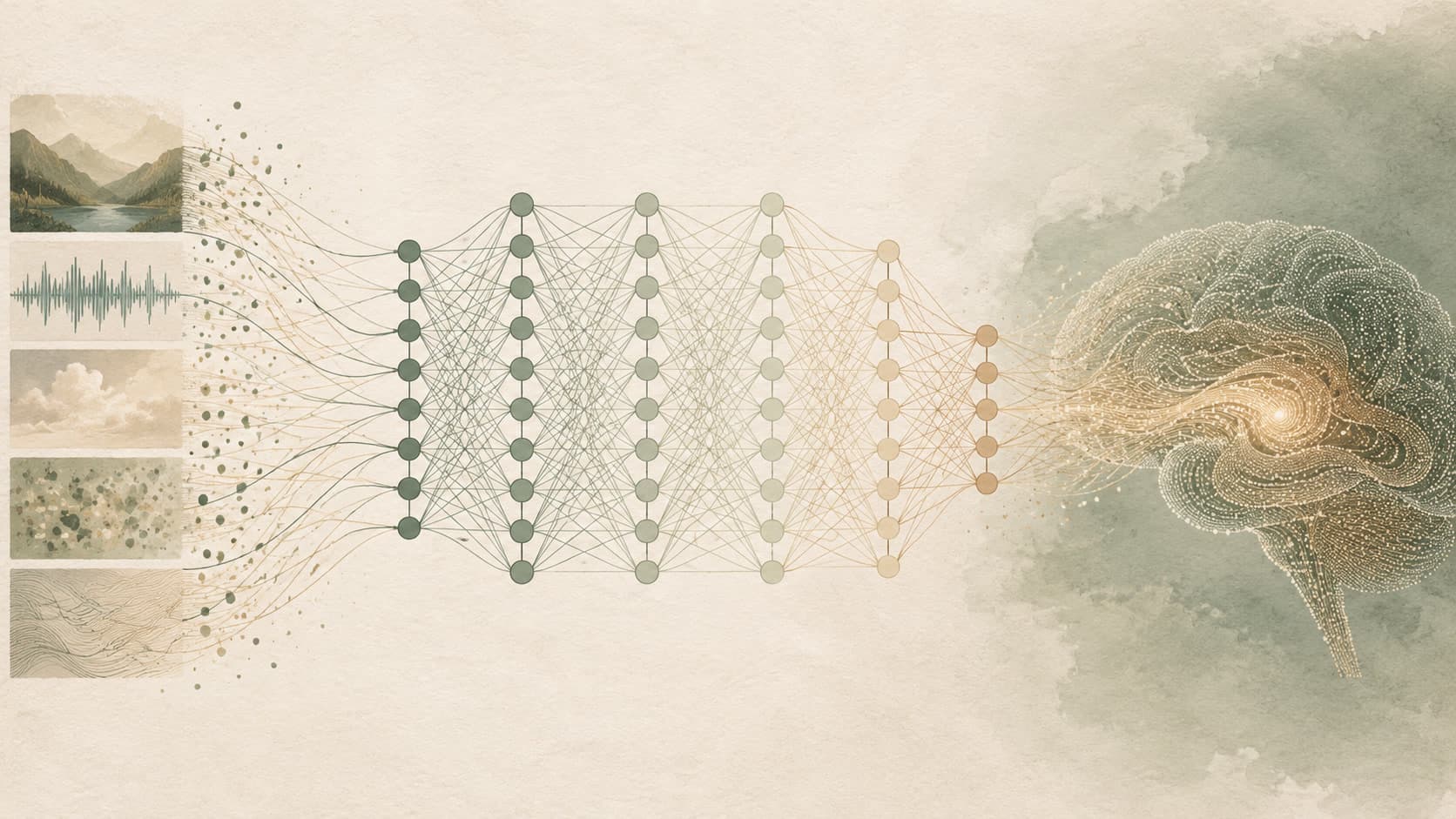
- Deep learning is a type of machine learning that uses many layered artificial neural networks to recognize patterns in images, sound, and text.
- Each layer learns progressively richer features — from edges and shapes to faces, voices, or meanings — without humans writing rules for every case.
- Most modern AI experiences you use daily, from voice assistants and photo search to chatbots and translation, are powered by deep learning.
What is Deep Learning?
Deep learning is a type of machine learning that teaches computers to recognize patterns using artificial neural networks with many stacked layers. Instead of telling the computer exactly how to detect a cat in a photo, a deep learning system looks at millions of pictures and gradually learns the patterns on its own.
The "deep" in deep learning refers to the number of layers in the network. Earlier neural networks had just one or two layers; modern deep learning models have dozens, sometimes hundreds. That depth is what allows them to handle messy, real-world data like photos, voice recordings, and free-form text.
Deep learning is the engine behind most of the AI products that became popular in recent years — voice assistants, photo search, recommendation feeds, language translation, and chatbots such as ChatGPT and Claude.
A Real-World Analogy
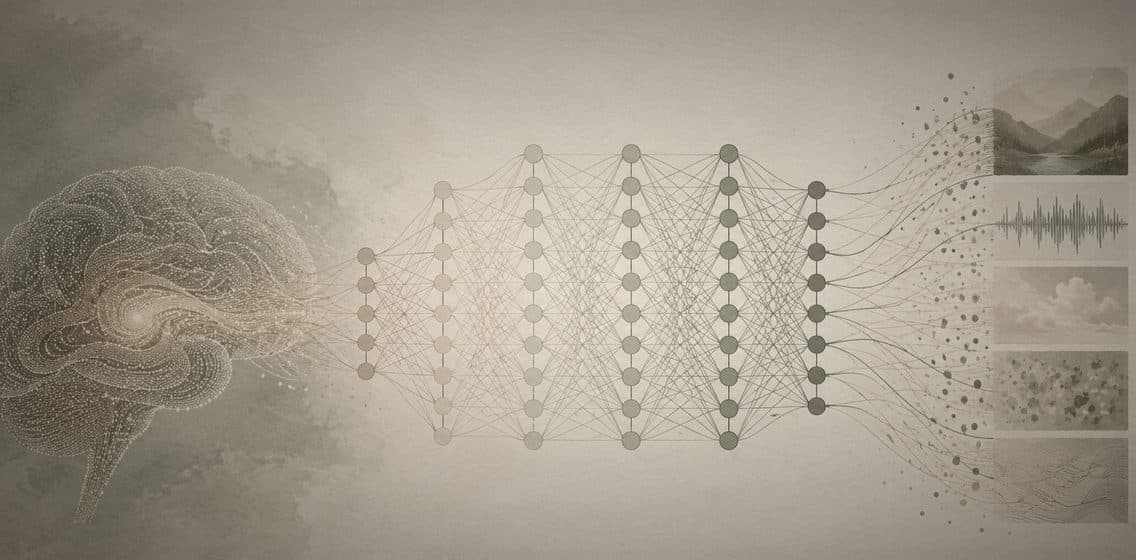
Imagine a long line of art students examining the same painting, one after another.
The first student only looks at tiny brushstrokes and reports, "I see edges and dots of color." The next student takes that report and notices simple shapes: "I see circles and lines." The student after that sees a face. The next sees an emotion: "The face looks sad." By the end of the line, a final student writes a one-sentence summary of the whole painting.
A deep learning model works just like that line of students. Each layer of the network takes the output of the previous layer and builds something more meaningful on top of it. The early layers catch raw details; deeper layers combine those details into concepts. The network as a whole learns to go from raw pixels (or audio, or characters) to a useful prediction like "this is a cat" or "this email is spam."
Why Does Deep Learning Matter?
Deep learning matters because it made many tasks possible that older software simply could not do well. Detecting objects in a photo, transcribing speech, recommending the right product, or translating between languages used to require enormous handwritten rule sets. Deep learning replaced those rules with learning from examples.
For everyday users and small businesses, deep learning means:
- Smarter products: Cameras that recognize people, e-commerce sites that recommend the right item, and email apps that finish your sentences.
- Voice as an interface: Voice assistants and meeting transcription now work well enough to be useful daily.
- Better automation: Bots and AI tools can read invoices, summarize documents, and draft replies in plain language.
- Faster innovation: Founders can use pre-trained deep learning models through APIs instead of training one from scratch, which used to take entire research teams.
Deep learning is not the only kind of AI, but it is the technology behind most of the breakthroughs people now call "AI" in daily life.
How It Works
Deep learning models are built from layers of simple math units, often called neurons, that are loosely inspired by the brain. Training one usually involves four big steps:
- Collect data with labels. For example, millions of photos labeled "cat" or "not cat," or sentences with their translations.
- Make predictions. The network takes an example and produces a guess based on its current internal numbers, called weights.
- Compare and adjust. The system measures how wrong the guess was and uses an algorithm called backpropagation to nudge the weights so the next prediction is a bit better.
- Repeat at huge scale. This loop runs across enormous datasets on powerful GPUs until the network's predictions are accurate enough to use.
Once trained, the model can be used on new, unseen inputs. Many modern systems also use transfer learning, where a large model is trained once on general data and then fine-tuned with a smaller, specific dataset — for example, a model that already understands English text being fine-tuned on a company's support tickets.
Large language models like ChatGPT and Claude are a specific kind of deep learning model, built on an architecture called the transformer.
Common Examples
| Where You Use It | What Deep Learning Does |
|---|---|
| Smartphone camera | Recognizes faces, scenes, and objects for autofocus and search |
| Voice assistants (Siri, Google Assistant) | Converts speech to text and understands commands |
| Streaming and shopping recommendations | Learns your preferences from past behavior |
| Email and chat autocomplete | Predicts the next word or sentence you might type |
| Translation apps | Maps sentences from one language to another |
| Self-driving features | Detects pedestrians, lanes, and other vehicles in real time |
| Chatbots like ChatGPT and Claude | Generate fluent, on-topic text from a short prompt |
If an app feels surprisingly smart, there is a good chance deep learning is involved somewhere underneath.
Key Takeaway
Deep learning is machine learning done with many layers of artificial neurons. By stacking simple math units into deep networks and training them on huge amounts of labeled data, computers can now recognize images, understand speech, generate text, and personalize recommendations at a level that was science fiction not long ago.
You do not need to build your own model to benefit from deep learning. Most of today's AI products you can subscribe to or call through an API are deep learning systems under the hood. Understanding what "deep" means — many layers learning richer and richer patterns — is enough to think clearly about where AI fits into your work and life.
Related Terms
- Machine Learning — The broader field of teaching computers from data; deep learning is one part of it.
- Neural Network — The basic structure of stacked layers that makes deep learning work.
- Large Language Model — A deep learning model specialized for understanding and generating text.
- Artificial Intelligence — The umbrella idea of building machines that perform tasks we associate with human intelligence.
- GPU — The specialized hardware that makes training large deep learning models practical.
Sources
- IBM — "What is deep learning?": A widely cited business overview of neural networks, layers, and deep learning use cases. (https://www.ibm.com/topics/deep-learning)
- MIT Technology Review — Artificial intelligence topic: Accessible articles on how modern AI models work and where they are heading. (https://www.technologyreview.com/topic/artificial-intelligence/)
- Google for Developers — Machine Learning Crash Course: Free educational material on neural networks, training, and modern deep learning. (https://developers.google.com/machine-learning/crash-course)